
Water Cooled Loads: The New Wave in Load Technology

•Electronic Loads
•Water-cooling versus Air-cooling
•Audible Noise
•Lower Cost and Greater Reliability
•Conclusion
Electronic loads were designed to accurately verify the operation of power sources over a wide range of voltage, current and power levels. Functions such as constant current, constant resistance, constant power and constant voltage have become standard in today's electronic loads used in production and test departments. Each serves to provide the user with the flexibility to use the load with various types of sources. Today, requirements for power sources have become much more stringent and the testing involved has become much more complicated. This, in conjunction with the need to test a multitude of voltage and current ranges, has highlighted the need for a reliable, high power electronic load.
As the power requirements of electronics continue to grow, the electronic load has also grown in order to keep pace with the needs of the power market. Previously, power levels of 3,000 watts were considered "high power". With the advancement of switch-mode technologies, battery cell densities and fuel cell advances, power levels above 100 kilowatts are not uncommon today.
Electronic loads convert electrical power into heat. The ability of the load to transfer this heat into the environment is the key to the overall power rating of the device. The two basic ways of removing heat are to simply force air over the heatsinks (as in Dynaload's RBL Series) or use water as the medium to cool the heatsinks (as in Dynaload's WCL Series) - Refer to Figure 1 below. Each of these methods has advantages and disadvantages that will now be reviewed in detail.
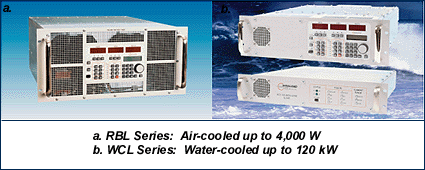
Water-cooling versus Air-cooling
Today's mechanical designs can safely and efficiently combine water and high power electronics in the same enclosure with essentially no effect on safety issues. Many steps have been taken to ensure that the water-cooled load is as safe a design as possible: Considerations for ease of installation, the possibility of internal condensation, and loss of water flow have all been addressed making the load virtually foolproof.
In an air-cooled design, the surface area of the heatsink, the airflow, and the temperature of the ambient air determine the heat transfer coefficient. In order to achieve higher power levels, the only choices are to increase the size of the heatsink, increase the airflow, or both. This philosophy will work when the power levels are relatively low and space is not limited. What drives the physical size of most electronic loads is the rate of power dissipation. The limiting factor in dissipation is always the maximum junction temperature of the semiconductors used to dissipate the power. The typical power semiconductor will have a maximum junction temperature of 150°C as an absolute limit. A review of the typical safe operating curves will show that different package styles offer different thermal transfer coefficients between the junction and case of the device (see Figure 2 below):
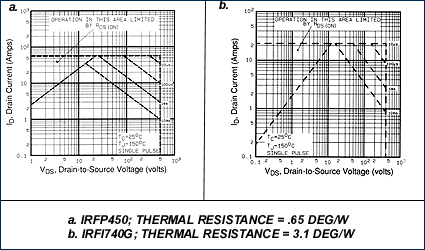
For example, in a typical air-cooled design the heatsink-to-air thermal transfer coefficient is 1.3°C/watt. With an airflow rate of 10CFM / watt, a MOSFET with a junction to case thermal coefficient of 0.8°C /watt (plus an additional 0.1°C/watt for an electrical insulator) would have a maximum power dissipation of 50 watts. At this point the junction temperature would reach 150°C and the component would fail. In order to reach a unit power level of 4,000 watts a total of 80 devices would be required. Since a typical air-cooled design can reach power densities of 1 to 1.2 watts per cubic inch in the 2,000 to 4,000 watt power range, increasing the air flow rate can present a significant challenge
In a water-cooled design, the water temperature and the flow rate determine the thermal transfer coefficient. By defining these two variables, the power density of a design can be extended to as high as 8.0 to 8.5 watts per cubic inch.
As compared to the previous calculation for power dissipation, the thermal transfer coefficient for the water-cooled heatsink is 0.02°C/watt. (This assumes a defined water temperature of 10°C and flow rate of 3.0 GPM) If we use the same MOSFET and insulator combination as the air-cooled approach, the junction temperature of the MOSFET would reach 150°C at a power level of 136 watts. To achieve the equivalent unit power level of 4,000 watts, we would only require 29 devices. This would greatly reduce the number of power devices along with the overall size of the enclosure.
As a result of a very efficient design layout and a reduced parts count, a 12-kilowatt water-cooled load would require as little as 3.5 inches of vertical rack space as compared to an air-cooled load, which would need 26.25 inches of rack space.
Another consideration in choosing air-cooled versus water-cooled is the noise level. If the work environment allows only minimal audible noise, an air-cooled load could present some difficulties. With a properly designed load the typical air flow requirements hover around 1 CFM of air for each 10 watts of power dissipation. This is not a consideration if the load requirement is below 1,000 watts where the airflow is relatively low. But as the power levels increase, the need for increased airflow will require larger fans, which can produce higher levels of audible noise. A typical 4,000 watt load would require approximately 400 CFM of air to maintain the desired heat transfer. Depending on the manufacturer, a fan this size could generate as much as 60 to 70 dB of noise. If there is only one load in the room the noise level may be tolerable, but if you had a requirement for many loads to be operating in the same room the combined noise levels could become overwhelming.
Choosing water-cooled loads does not necessarily mean that noise will not be an issue. Though the loads themselves will not produce any noise at all, the heat exchanger or chiller needed to cool the water may generate some noise. The advantage of water-cooling, however, is the ability to locate the chiller in an area where noise is not an issue. This could be a remote location within the facility or even outside depending upon convenience. Many manufacturing facilities now have water processing plants installed thereby making chilled water as convenient as standard wall plugs.
Contents
Lower Cost and Greater Reliability
There are two other factors which come into play when deciding between air-cooled and water-cooled electronic loads: maximizing reliability and minimizing cost. By increasing the power dissipation of the individual semiconductors, the water-cooled electronic load will now need fewer devices to achieve much greater power levels. A lower parts count translates directly into greater reliability and a much lower cost to manufacture. Another notable effect of the lower parts count is the reduced size of the load enclosure. The net effect to the end-user is a much lower total ownership cost.
A water-cooled load will cost approximately $1.00 per watt and represents significant savings over traditional air-cooled loads that cost approximately $3.00 per watt. The water-cooled load may have additional costs associated with it if processed water is not readily available: A high-end laboratory grade water chiller can add $1.50 per watt. However, since most applications do not require an elaborate water chiller, this cost can be greatly reduced. Costs as low as $0.15 per watt can be achieved if the proper research of chiller manufacturers is explored.
In order to provide the user with a flexible installation procedure, the water-cooled load uses ½-inch NPT inlet and outlet connections on the rear of the unit. This allows the customer to adapt the water lines to fit the preferred connector style. These could be "quick connects", garden hose, or even hard pipe whichever meets the requirement. A quick trip to the hardware store will provide a wide selection of adapters from which to choose.
It would not be fair to say that water-cooling is the great savior of the electronic load world. Each manufacturer of power sources has their own individual and unique requirements and each must weigh the advantages of a water-cooled load over a traditional air-cooled load.
The following table provides the advantages versus the disadvantages of each method.
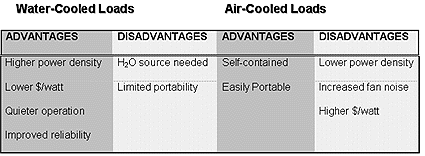
Different power and current levels will dictate whether water-cooling is even applicable. However, with the advent of the water-cooled load, the capabilities of the test engineer are significantly enhanced and provide a modern day technology stimulus to test equipment in a compact, economical and convenient form.